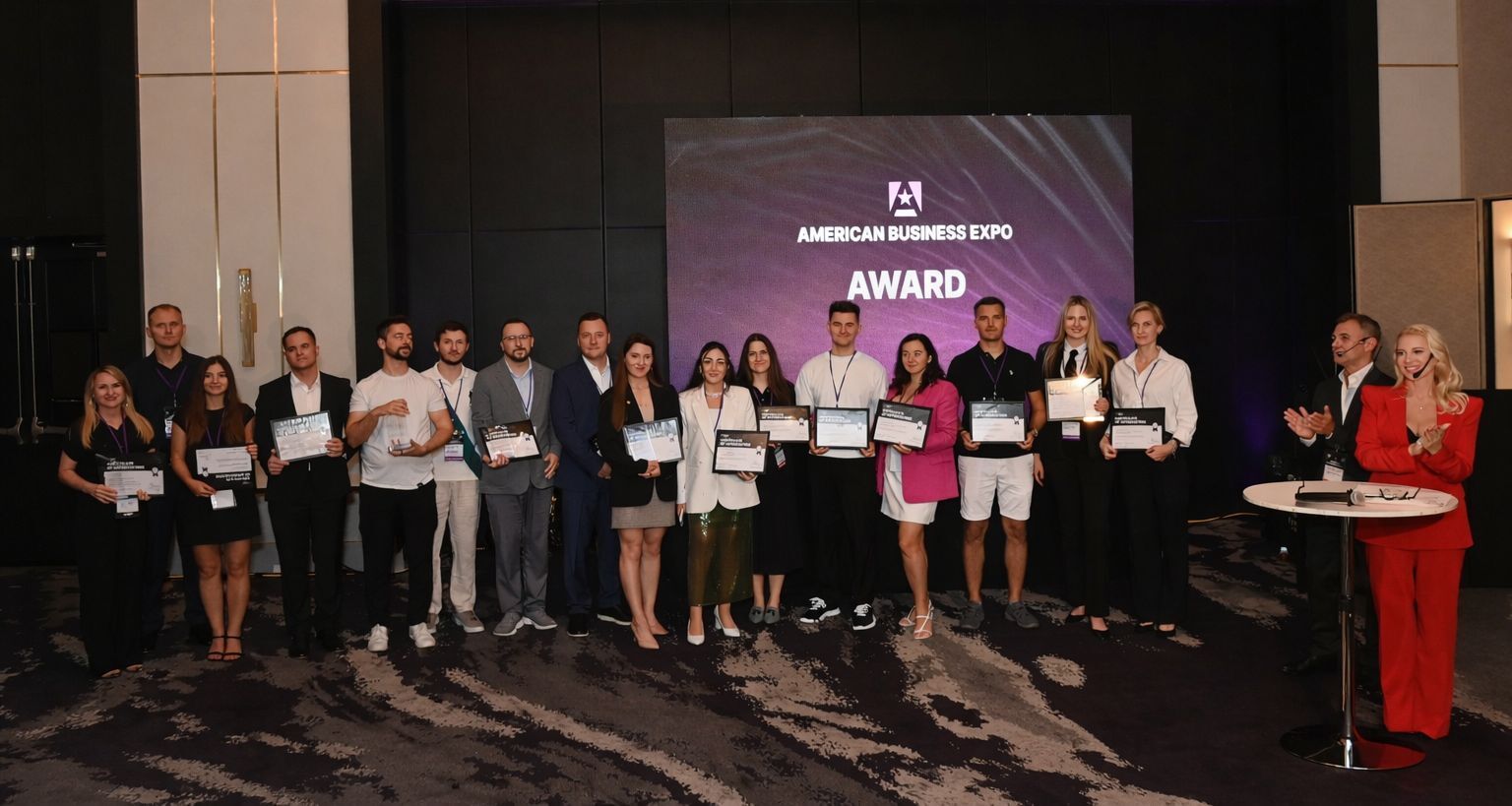
On December 28, 2025, over 1,000 entrepreneurs, founders, and investors gathered at Hilton Aventura in Florida for the American Business Expo. In an era of conference fatigue and Zoom oversaturation, what pulled more than a thousand people together just days after Christmas? Those 1,000 business builders went to Miami to close deals, allocate funds, establish new connections, and reconnect with long-standing partners in person. Chance encounters, shared joy, and long-awaited reunion hugs added to a Christmas-like atmosphere that felt less like a conference and more like friends gathering in Florida’s sunny middle of winter.
The American Business Expo was designed for efficiency, featuring a trading floor divided into three exchange zones. In a dedicated capital allocation space, investors and founders discussed markets and institutional deployment. On another stage, operators exchanged playbooks for scaling real systems. In the expo zone, participants explored booths representing companies across AI, IT, media, investments, real estate, consulting, logistics, medical and beauty technologies, construction, and design. As the day came to a close, the main stage filled to capacity. The awards ceremony, Meta Quest Pro giveaway, and live music kept guests in the venue until the lights finally went out.
The Foundations of Execution
The Main Stage programming delivered a clear thesis: after years of purely digital speculation, capital had begun returning to the physical world. Across panels and keynotes, speakers argued that the next decade would belong to founders able to bridge digital intelligence with material reality—energy grids, manufacturing capacity, and institutional infrastructure. Conversations centered on what actually moves businesses forward: investment strategies grounded in data rather than hype, technology that translates into tangible infrastructure, and policy frameworks that allow capital to flow into emerging sectors. The throughline was execution over abstraction, matter over marketing.
Dmitry Kotov, founder of Neuron Expert Corporation and leader of Crazy Unicorns, used his talk not to echo the consensus but to challenge the audience on its implications. In “The Return of Matter – How Energy, Metals, and Physical Reality Are Restoring Meaning to Capital,” he argued that the shift back to physical assets would expose a hard divide: between founders who can operate within real-world constraints and those whose models collapse once software meets supply chains, regulation, and physics. Kotov spoke less about opportunity and more about accountability—the point at which capital stops rewarding vision and starts demanding operational depth. Having built multiple technology companies and large-scale tech communities across the United States, he positioned himself squarely on the side of execution. His message landed not as a trend forecast, but as a warning: the era of frictionless stories was ending.
The day’s special guest, Chairman Bowdre, extended the conversation with “The Making of a Crypto Capital: Miami’s 2025 Results and the Next Phase of Institutional Scale.” As Executive Director of the Miami-Dade Digital Commission and Chair of Miami’s crypto initiatives, Bowdre outlined how policy had enabled institutional capital to flow into digital innovation. His approach positioned Miami as a testing ground where public policy and emerging technology could converge. For founders building in crypto or Web3, the message was clear: the next phase was about institutional adoption—and Miami was already writing the playbook.
The Living Ecosystem
The Business Stage and broader program reinforced the execution ethos. Sessions covered leadership under uncertainty, entrepreneurial responsibility, and the fundamentals that scale businesses—not the kind of inspirational fluff that sounds good on social media, but the operational details that determine whether a company survives year two. Speakers focused on people, decisions, and outcomes, creating space for founders to walk away with new knowledge, new clients, new partners, or all three.
Meanwhile, the expo zone hummed with actual transactions. Operating businesses filled the floor—not startups pitching slide decks, but companies with active products and live services ready to contract. PropTech platforms connected with real estate investors scouting for deployment opportunities. AI automation firms walked prospects through live demos and discussed implementation timelines. Logistics companies met e-commerce founders who needed better last-mile solutions yesterday, not next quarter. By late afternoon, the energy in the hall made one thing clear: this wasn’t networking for networking’s sake. Deals were closing before the awards ceremony even began.
The awards ceremony that closed the day sent a message of validation for execution, not potential. It was not the primary focus of the event, but rather a conclusion that followed hours of substantive conversations, meetings, and presentations. The American Business Expo Award recognized professional achievements across 131 categories, with participants from 20 countries—from the United States to Sri Lanka, from Canada to the UAE—selected through independent jury evaluation and a merit-based process.
Recognition That Validates Execution
As the main stage filled up again around 6:30 PM, the awards ceremony shifted the day’s focus from building to recognizing those who had already built. The American Business Expo Awards marked the conclusion of nine hours of substantive conversations, partnership meetings, and contract negotiations. It carried weight precisely because of its positioning: recognition followed execution, not the other way around.
An independent international jury evaluated submissions across 131 categories, with participants from 20 countries spanning the United States to Sri Lanka, Canada to the UAE. Evaluation criteria centered on innovation, execution quality, business impact, and leadership—measured by the ability to create products that ship and businesses that scale. Jury members brought their own operational credibility to the process: entrepreneurs who had built companies and technologies and solved real-world problems.
The awards illustrated both the range of the event and the execution standard that defined it. Vladyslav Budichenko won Solution of the Year in Software Development for creating Vocaly AI, an autonomous voice platform enabling businesses to handle customer communication at scale. The award was presented by jury member Viktoriia Filieieva, founder of SmileSafe AI. Igor Astrakhovych received Innovation of the Year in CleanTech for developing industrial restoration technologies that reduced equipment repair cycles from weeks to days—a tangible infrastructure play that resonated strongly with the themes of the morning keynote. His work was validated by jury member Artem Kozhevnikov, a published author with expertise in evidence-based innovation.
Across categories, the pattern held: measurable impact, proven systems, and businesses already operating at scale.
What This Signals About 2026
The American Business Expo reflected where entrepreneurship was heading in 2026. It established an environment where execution and positive impact were valued over branding and rhetoric, and it demonstrated emerging market mechanisms for separating signal from noise. The event functioned as a sorting process—showing, through real transactions and validated recognition, who had earned their position in the ecosystem.
The fact that more than 1,000 people chose to spend December 28 at a business conference rather than extending their holiday break sent a clear signal. In 2026, the gap between founders who optimize for visibility and those who optimize for execution was already widening. The market was beginning to reward builders who could prove their systems worked at scale, and businesses that shipped products built for the material world. The American Business Expo made that shift visible by creating a marketplace where ideas met capital, technology met infrastructure, and reputation was measured in closed deals rather than follower counts.
